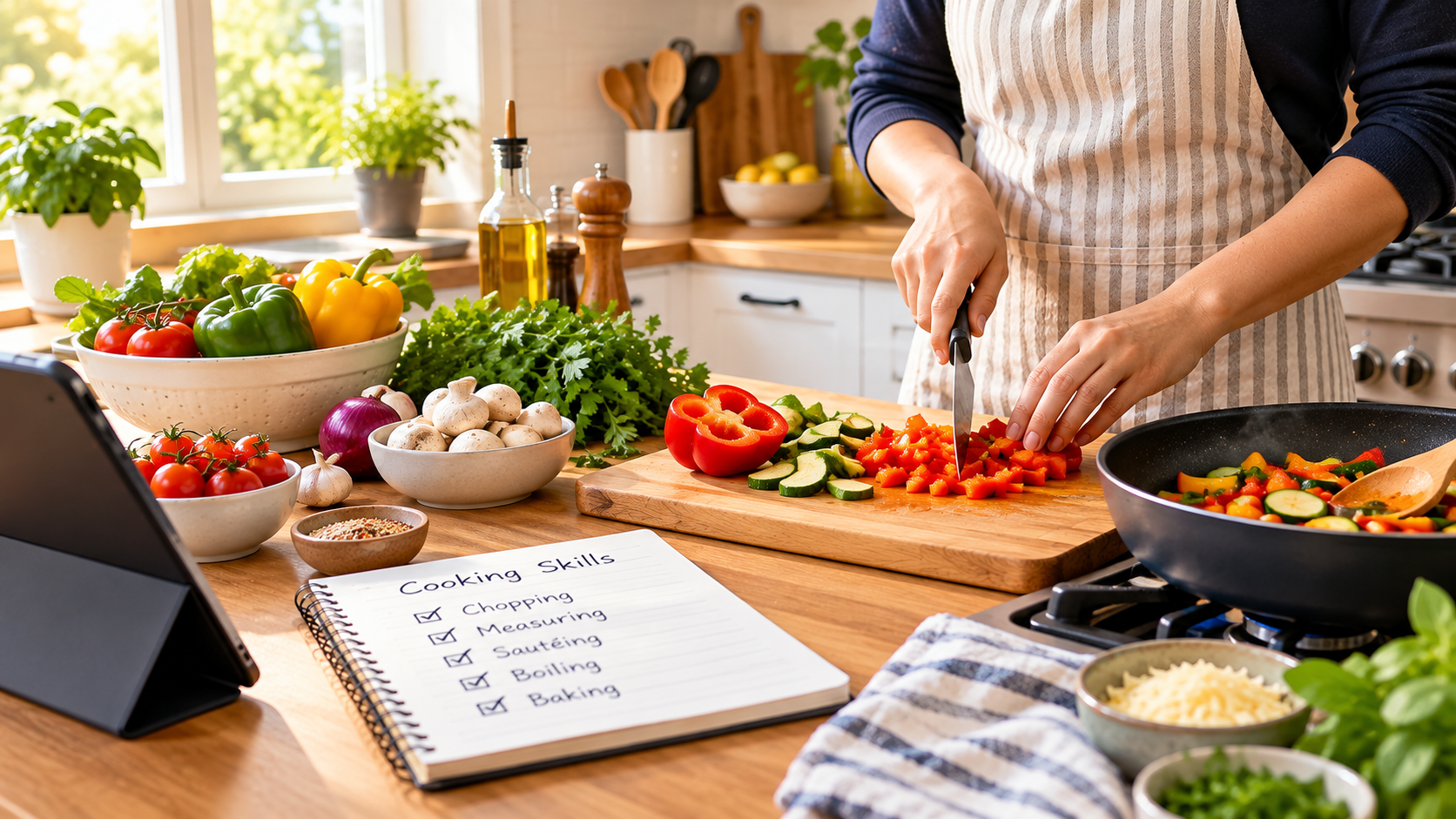
Cooking becomes much less intimidating once you stop thinking of it as a collection of complicated recipes and start treating it as a set of practical skills. A beginner does not need an expensive kitchen, dozens of gadgets, or years of culinary training to make good food. A handful of fundamentals—handling a knife, controlling heat, seasoning properly, and understanding how ingredients behave—can transform everyday cooking.
The encouraging part is that these skills can be learned progressively. You can practice one at a time, use ordinary ingredients, and become noticeably more confident within a few weeks. The goal is not perfection. It is learning how to make sensible decisions when something does not go exactly according to the recipe.
1. Learn to Handle a Knife Safely
Knife skills are one of the first foundations worth learning because almost every savory meal involves some chopping, slicing, or cutting. You do not need professional speed. In fact, rushing is one of the easiest ways for a beginner to lose control of a knife.
Start by learning how to hold the knife securely and keep your cutting board stable. Place a damp kitchen towel underneath a board that tends to slide. When cutting, curl the fingers of your guiding hand slightly so your knuckles can help protect your fingertips.
Practice with forgiving ingredients such as potatoes, carrots, onions, or zucchini. Focus on producing reasonably similar pieces rather than perfectly shaped vegetables. Similar-sized pieces cook at roughly the same rate, which is far more important than appearance.
- Keep your knife reasonably sharp rather than forcing a dull blade through food.
- Use a stable cutting surface.
- Slow down when learning a new cutting technique.
- Keep your attention on the knife instead of multitasking.
2. Understand What Heat Actually Does
Many disappointing meals are not caused by bad ingredients. They happen because the cook has little control over heat. A pan that is too cool can leave food pale and greasy, while excessive heat can burn the outside before the inside is properly cooked.
Begin by becoming familiar with low, medium, and high heat on your own stove. Different cooktops and pans behave differently, so the number on a dial is less useful than observing what is happening in the pan.
Useful for gentle cooking, melting, warming, and reducing the risk of scorching.
A practical range for many everyday tasks such as sautéing vegetables and cooking eggs.
Useful for rapid boiling or developing strong browning, but it requires close attention.
One particularly useful habit is allowing a pan to preheat when the recipe calls for it. Another is avoiding overcrowding. Too much food in a pan can release moisture faster than it can evaporate, causing ingredients to steam instead of brown.
3. Get Comfortable With Seasoning
Seasoning is more than adding salt at the end. It is the process of developing and balancing flavor throughout cooking. Beginners often make one of two mistakes: seasoning too little because they are afraid of salt, or adding a large amount at once and losing control.
Instead, taste food at appropriate stages. When safe and practical, taste a sauce, soup, cooked vegetable, or other component before serving. Ask what it needs rather than automatically adding more salt.
Salt can sharpen flavor, acidity can brighten a dish, sweetness can soften harsh notes, and fat can carry richness. Herbs, spices, garlic, ginger, and aromatics add their own layers rather than simply making food “stronger.”
A small amount of lemon juice, vinegar, or another acidic ingredient can sometimes make a dish taste more complete without requiring more salt. Learning to recognize that difference is one of the most valuable steps toward cooking intuitively.
4. Learn a Few Core Cooking Methods
You do not need to memorize hundreds of techniques. Start with the methods that appear repeatedly in everyday cooking. Once you understand them, unfamiliar recipes become easier to follow.
- Sautéing: Cooking relatively small pieces of food quickly in a pan with a modest amount of fat.
- Roasting: Using dry oven heat to cook and brown ingredients, particularly vegetables, meats, and poultry.
- Boiling: Cooking food in vigorously bubbling liquid, useful for pasta and certain vegetables.
- Simmering: Cooking gently in liquid with smaller, steadier bubbles—useful for soups, sauces, beans, and stews.
- Steaming: Cooking with hot vapor rather than placing food directly in boiling water.
- Baking: Using controlled oven heat to transform mixtures such as breads, cakes, and baked dishes.
Practice these techniques individually. For example, roast a tray of mixed vegetables and pay attention to how size, oil, spacing, and oven temperature affect the result. That single exercise teaches more than simply following a recipe mechanically.
5. Learn How to Read a Recipe Before Cooking
Experienced cooks often appear fast because much of their work happens before the heat is turned on. They have already read the recipe, identified the sequence, and prepared the ingredients they will need.
Before beginning, read the complete recipe once. Look for ingredients that need to be brought to room temperature, equipment that needs to be preheated, or components that require extra cooking time.
A simple pre-cooking routine
① Read the recipe from beginning to end.
② Check that the necessary ingredients are available.
③ Prepare and measure ingredients where practical.
④ Set out the required pan, knife, board, and utensils.
⑤ Identify which steps happen simultaneously.
This preparation, sometimes called mise en place, does not mean every ingredient must be arranged in tiny bowls. It simply means being organized enough that you are not frantically searching for ingredients while something is already cooking.
6. Practice Cooking Eggs
Eggs are inexpensive, versatile, and excellent for learning heat control. Try scrambled eggs, fried eggs, hard- or soft-cooked eggs, and a basic omelet. Each method teaches something different about temperature and timing.
Scrambled eggs are especially useful because beginners can see how gentle heat changes texture. High heat may cook them quickly but can produce a dry, firm result. Lower heat gives you more time to observe and adjust.
Do not worry if the first few attempts are imperfect. Eggs provide immediate feedback, making them one of the best practice foods for learning.
7. Understand Food Safety From the Beginning
Good cooking includes safe handling, not just good flavor. Make handwashing, clean preparation surfaces, and sensible food storage part of your normal routine.
Keep raw meat and seafood separate from foods that are ready to eat. Use appropriate utensils and cutting boards, refrigerate perishable foods promptly, and cook foods to safe internal temperatures rather than relying solely on appearance.
When cooking meat, poultry, or other foods where appearance is an unreliable safety indicator, use a food thermometer. It removes much of the guesswork and is more dependable than cutting into food repeatedly.
8. Learn to Fix Small Cooking Mistakes
This is where cooking starts becoming a genuine skill rather than recipe following. A soup that tastes flat, a sauce that is too thick, or vegetables that have browned too quickly does not automatically mean dinner is ruined.
Pause and identify the actual problem. If a dish tastes flat, it may need salt, acidity, aromatics, or another flavor element. If a sauce is too thick, a suitable liquid may loosen it. If food is browning too rapidly, reducing the heat can prevent further damage.
The important lesson is to make one adjustment at a time. Adding several ingredients simultaneously makes it difficult to understand what improved—or worsened—the dish.
9. Build Skill Through Simple Meals
Rather than constantly choosing complicated recipes, repeat a few straightforward meals until their basic techniques become familiar. A vegetable stir-fry, roasted chicken with vegetables, pasta with a simple sauce, soup, grain bowl, or bean-based meal can provide plenty of practice.
After cooking, take a minute to think about the result. Was the food too salty? Did the vegetables become soft before they browned? Did the pasta sauce need more acidity? Was the preparation rushed?
That short review is surprisingly powerful. Each meal becomes a practical lesson instead of simply something you ate.
A Beginner’s Four-Week Practice Path
| Week | Main focus | Practice idea |
|---|---|---|
| 1 | Knife skills and organization | Prepare vegetables for several simple meals. |
| 2 | Heat and seasoning | Cook vegetables, eggs, and a basic pan sauce. |
| 3 | Cooking methods | Try roasting, sautéing, simmering, and steaming. |
| 4 | Combining skills | Cook complete meals while adjusting seasoning and timing yourself. |
What Beginners Should Not Worry About Yet
It is easy to become distracted by specialized cookware, complicated plating techniques, restaurant-style terminology, and enormous collections of spices. Most beginners will gain more from learning to control a single skillet than from buying ten additional kitchen tools.
Start with a reliable knife, cutting board, saucepan, skillet, baking tray, basic utensils, and a thermometer. Add equipment only when a specific cooking habit gives you a reason to need it.
The real measure of progress
You are becoming a better cook when you can look at a dish and make an informed adjustment without immediately searching for another recipe. Confidence comes from understanding cause and effect: more heat changes browning, smaller pieces cook faster, seasoning changes perception, and timing affects texture.
Final Thoughts
Essential cooking skills are learned through repetition, observation, and a willingness to make small mistakes. Begin with safe knife handling, heat control, seasoning, basic cooking methods, recipe organization, and food safety. Then gradually move toward combining those skills in complete meals.
The most useful milestone is not being able to cook an impressive dish once. It is being able to open the refrigerator, work with what you have, and prepare something satisfying without feeling overwhelmed. Once that happens, recipes become useful guides rather than strict instructions—and cooking starts to feel much more natural.