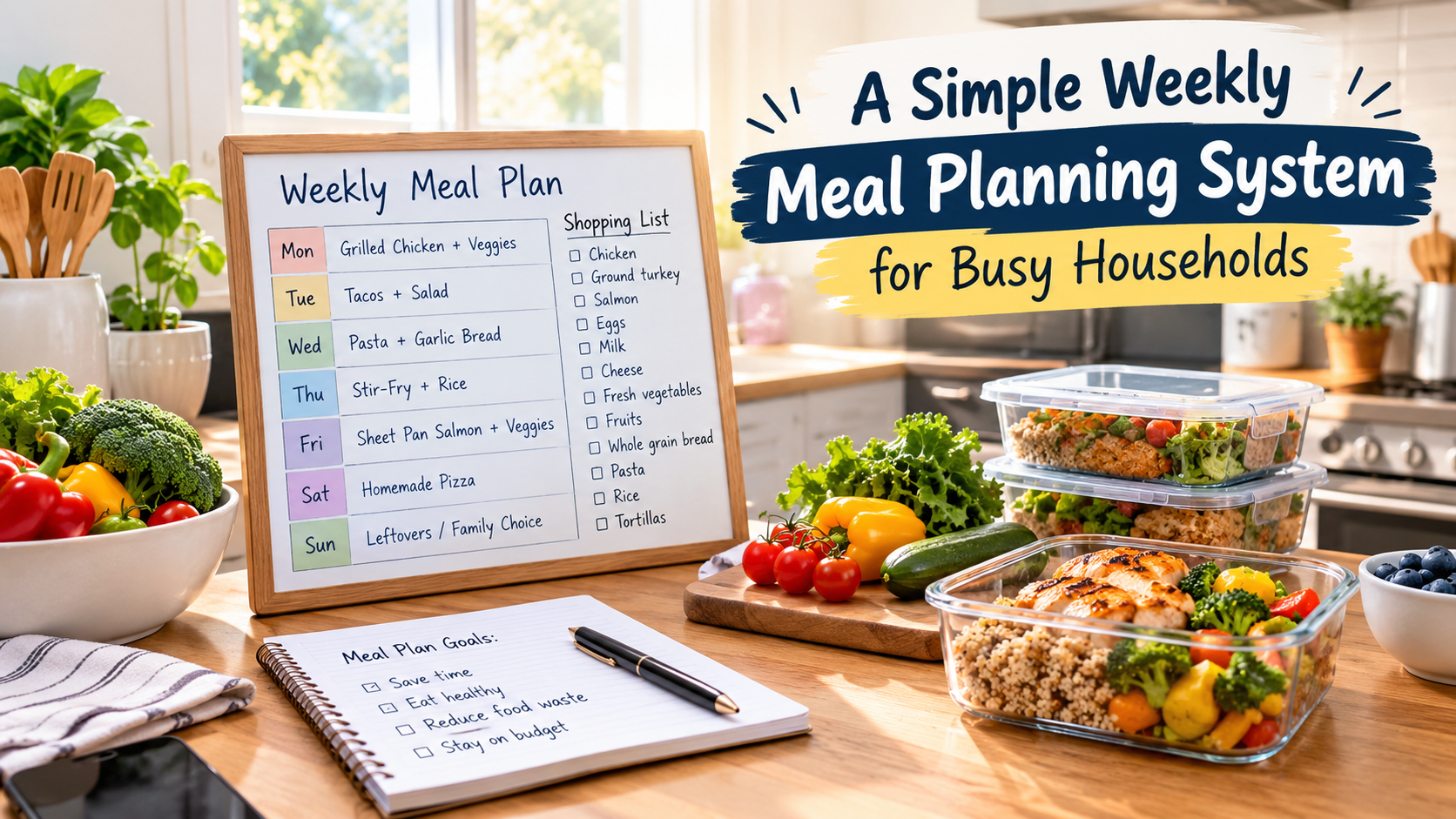
Weekly meal planning sounds useful in theory, but busy households often discover that an overly detailed plan creates another chore. Between work schedules, school activities, appointments, changing appetites, and unexpected evenings, a rigid menu can become difficult to maintain.
A better system is flexible enough to survive a busy week. Instead of deciding every detail seven days in advance, build a small collection of dependable meals, organize ingredients around them, and deliberately leave room for leftovers and last-minute changes.
Why Simple Planning Works Better
The purpose of meal planning is not to make your household follow a perfect schedule. It is to reduce the number of food-related decisions you have to make when everyone is already tired or busy.
Without a plan, the same questions appear repeatedly: What should we eat tonight? Do we have anything in the refrigerator? Should someone go shopping? Can we make dinner quickly? A simple weekly system answers most of those questions before the hectic part of the day arrives.
The strongest plans also account for real life. A family may intend to cook five nights but end up eating out once, ordering takeout once, and turning one dinner into leftovers. A useful system accommodates that rather than treating it as a failure.
Know the general plan before hunger and fatigue arrive.
Buy ingredients with several possible uses.
Move meals around when the week does not go as expected.
Start With a Weekly Meal Framework
Rather than assigning a completely different recipe to every day, give each day a general purpose. This makes planning faster and allows you to change the actual dish without rebuilding the entire schedule.
This framework is deliberately broad. Monday could be tacos one week and pasta the next. The category remains useful even when the menu changes.
Build a Personal List of Go-To Meals
Busy households benefit enormously from having a short list of meals that can be prepared without much thought. These are not necessarily your most impressive recipes. They are the meals that people in the household generally enjoy and that you know how to prepare comfortably.
Create three groups:
- Fast meals: dishes that can be prepared in roughly 15–25 minutes.
- Regular meals: dependable dinners that take a little more preparation.
- Flexible meals: dishes that can absorb whatever vegetables, grains, proteins, or leftovers are available.
Once you have ten to fifteen dependable options, weekly planning becomes much easier. You are selecting from a familiar menu instead of searching the internet for dinner inspiration every afternoon.
A practical test for a go-to meal
If you can explain how to make it without constantly checking instructions, the ingredients are easy to find, and your household usually enjoys it, it belongs on your dependable-meal list.
Plan Around Ingredients That Can Work Twice
One of the smartest ways to simplify grocery shopping is to think about ingredients across several meals. Buying a large collection of unrelated ingredients creates clutter, increases spending, and often leaves small quantities unused.
Instead, choose ingredients with multiple jobs. A container of cooked chicken might serve as dinner one night and become the filling for wraps the next day. Roasted vegetables can accompany one meal and later be added to eggs, pasta, or a grain bowl.
The same principle applies to staples. Rice, potatoes, pasta, beans, tortillas, eggs, frozen vegetables, and canned tomatoes can support a surprising number of uncomplicated meals.
Use the “Cook Once, Use Twice” Principle
This does not mean preparing an enormous batch of every ingredient. It simply means noticing opportunities to save work.
Cook once
Prepare a useful quantity of rice, roasted vegetables, beans, or another suitable component.
Use twice
Build the same component into another meal in a different, simple format.
This approach saves preparation time without forcing the household to eat exactly the same dinner two nights in a row.
Give the Grocery List a Clear Structure
A meal plan works best when the shopping list is created from the meals rather than from random ingredients that happen to look appealing at the store.
After selecting your meals, review the ingredients and group the shopping list into categories. This makes shopping faster and helps reveal duplicate purchases.
Before shopping, check your refrigerator, freezer, and pantry. The most economical ingredient is often the one you already have.
Create a “Busy Night” Category
Every household has evenings when the original plan simply will not work. A useful meal planning system anticipates this instead of pretending those evenings will not happen.
Choose several meals that require little preparation. Frozen vegetables with eggs, sandwiches with a side salad, a quick pasta dish, soup and toast, rice bowls, or another household favorite can fill this role.
Keep a few suitable ingredients available specifically for these situations. Knowing that an easy dinner is waiting can prevent a rushed evening from turning into unnecessary stress.
Leave One or Two Spaces Open
A seven-day calendar does not need seven fixed dinners. Leaving some space open is actually one of the strengths of a flexible system.
Perhaps Wednesday becomes leftover night. Friday may become an evening out. Saturday could be the day when someone in the household wants to experiment with cooking. Keeping some flexibility prevents food from being prepared simply because the calendar says it should be.
Think in terms of anchors
Choose three or four meals that definitely need ingredients, then allow the remaining meals to develop around leftovers, pantry staples, schedules, and appetite. This creates structure without turning dinner into an obligation.
Make Breakfast and Lunch Easier Too
Meal planning often focuses heavily on dinner while ignoring the meals that can create just as much daily decision-making. Breakfast and lunch do not need elaborate weekly menus, though.
Choose a few repeatable options. Overnight oats, eggs and toast, yogurt with fruit, simple sandwiches, grain bowls, leftovers, salads with a reliable protein, or soup can provide variety without requiring a new recipe every day.
For households with children, it can be particularly helpful to keep a short list of acceptable breakfast and lunch combinations. Familiar choices make mornings more predictable.
Use a Weekly Planning Session That Takes Less Than Half an Hour
Meal planning should not consume an entire evening. Pick a consistent time once a week and follow the same sequence.
- Check the calendar. Identify late workdays, activities, appointments, and evenings when cooking will be difficult.
- Check existing food. Look for ingredients that need to be used soon.
- Select three or four main meals. Choose recipes appropriate for the week’s schedule.
- Add leftovers and easy meals. Do not fill every space with a cooking project.
- Build the shopping list. Buy only what supports the plan and useful staples.
- Identify one backup. Make sure there is an easy option for an unexpectedly difficult day.
With practice, this process becomes much faster because you are working from a familiar collection of meals.
Avoid the Most Common Planning Problems
Novelty sounds exciting until several complicated meals land on the same busy week.
A recipe that takes an hour may not belong on the evening with three appointments.
Duplicate ingredients can increase costs while older food gets forgotten.
A flexible schedule is easier to maintain than one that assumes every day will go perfectly.
Review the System at the End of the Week
A meal planning system should improve with use. At the end of each week, spend a few minutes looking at what actually happened.
| Ask | Why it matters |
|---|---|
| Which meals were easiest? | Keep successful options in regular rotation. |
| What food was wasted? | Adjust quantities or find another use next week. |
| Which night was hardest? | Schedule a faster meal for that day in the future. |
| What did everyone enjoy? | Build your future menu around meals people genuinely want to eat. |
The Best Meal Plan Is the One You Can Keep Using
A successful weekly meal planning system should reduce work, not create another demanding household project. The most practical approach is to plan around your actual schedule, keep several dependable meals in rotation, reuse ingredients thoughtfully, and reserve space for leftovers and unexpected changes.
You do not need a perfect menu, a refrigerator full of identical containers, or a complicated spreadsheet. A short planning session, a sensible grocery list, and a handful of reliable meals can be enough to make the entire week feel more organized.
Make Dinner Easier, Not Perfect
Think of weekly meal planning as a safety net rather than a strict timetable. Plan enough to know what food is available, prepare enough to save future effort, and leave enough flexibility for real life.
Once that balance becomes routine, feeding a busy household becomes less about making constant decisions and more about following a simple system that quietly does the work in the background.