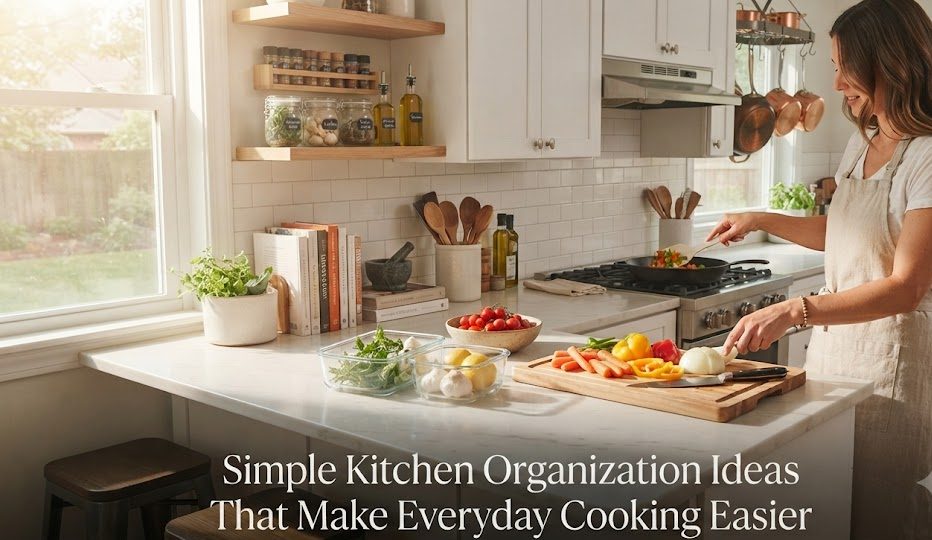
Organize Your Kitchen Around the Way You Actually Cook
A well-organized kitchen does more than look tidy. It helps you find ingredients faster, move comfortably between tasks, and spend less time searching, sorting, and cleaning while preparing everyday meals.
Cooking at home becomes much easier when the kitchen works with you instead of against you. A crowded drawer, an overfilled pantry, or frequently used tools stored in inconvenient places can turn a simple meal into a surprisingly long task.
You do not need expensive organizers or a complete kitchen makeover to solve these problems. Small changes to where things live can make everyday cooking more comfortable and efficient.
Begin With the Things You Use Most
One of the simplest organization principles is to give the most convenient storage locations to the items you reach for regularly.
Your everyday pan, favorite cutting board, cooking utensils, frequently used spices, and basic ingredients should not require a complicated search. Less frequently used equipment can occupy less accessible spaces.
Daily essentials
Keep everyday tools and ingredients close to your main preparation area.
Occasional items
Store specialty equipment and rarely used supplies in less convenient locations.
Create Simple Kitchen Zones
Instead of organizing the kitchen only by cabinet or drawer, think about the activities that happen there. Creating loose zones can make it easier to complete each task without repeatedly crossing the entire room.
Preparation zone: Cutting boards, knives, mixing bowls, and other preparation tools.
Cooking zone: Pots, pans, cooking utensils, and seasonings used near the stove.
Storage zone: Pantry staples and ingredients grouped according to how often they are used.
Cleaning zone: Dishwashing supplies and cleaning tools kept together.
These zones do not need strict boundaries. Their purpose is simply to make the kitchen more predictable.
Keep Your Main Counter Clear
Counter space is one of the most valuable resources in a kitchen. When it becomes covered with appliances, packaging, containers, and miscellaneous objects, there is less room for actual food preparation.
Try keeping only the equipment you use frequently on the counter. Everything else can be stored nearby and brought out when needed.
A useful counter test
Look at each item sitting on your counter and ask: Do I use this often enough to justify permanent counter space? If not, give it another home.
Organize Drawers by Task
Kitchen drawers can quickly become difficult to manage because different types of tools get mixed together. Instead of putting utensils wherever there is room, group them according to what you use them for.
One drawer might hold everyday cooking utensils, another could contain measuring tools, and another could be reserved for preparation accessories. The exact arrangement depends on your kitchen and habits.
The important part is that every category has a predictable home.
Make Pantry Ingredients Easy to Scan
A pantry becomes much easier to use when you can see what you have without moving several packages aside. Group similar foods together and avoid creating deep piles whenever possible.
You might arrange staples in one area, breakfast foods in another, baking ingredients separately, and snacks in a clearly defined section. If your household uses certain ingredients daily, place them where they are easy to reach.
Frequently used basics
Items used for regular dishes
Flours, sugars, and baking supplies
Less frequently used items
Arrange the Refrigerator by Use
A refrigerator can become disorganized quickly when groceries are placed wherever there happens to be space. Grouping similar items makes it easier to identify what needs to be used.
For example, you can create a practical area for ready-to-eat foods, another for ingredients used frequently, and a visible section for foods that should be used soon.
Do not forget the refrigerator door and smaller compartments. These areas can be useful for suitable items that you reach for regularly, while foods that require more stable temperatures should be stored according to appropriate food-storage practices.
Create a “Use Soon” Area
One small organizational feature can have a surprisingly large impact: a clearly visible place for ingredients that should be used before newer purchases.
This could be a refrigerator container, a pantry basket, or simply a designated shelf. When ingredients are visible, you are more likely to remember them while planning meals.
During a quick kitchen reset, move ingredients that need attention into one visible area. Then check that area before adding new items to your weekly meal plan.
Store Cooking Tools Near Their Point of Use
If you constantly walk across the kitchen to retrieve a utensil, the storage location may not be ideal. Consider where an item is actually used rather than where it happens to fit.
Cooking utensils can stay near the stove, preparation tools near the main work surface, and baking equipment near the ingredients you commonly use with it.
This simple adjustment can make the kitchen feel more efficient without purchasing anything new.
Reduce Duplicate Items
Many kitchens become crowded because they contain several versions of tools that perform almost the same job. If you have multiple measuring sets, several similar serving utensils, or appliances you rarely use, evaluate whether all of them deserve storage space.
You do not have to remove everything that is not used daily. Instead, identify items that are broken, duplicated unnecessarily, or consistently difficult to store.
A simple sorting method
- Keep: Useful items that earn their space.
- Relocate: Useful items that are stored in the wrong area.
- Review: Duplicates or rarely used equipment.
- Remove: Broken or unnecessary items.
Make Spices Easier to Find
Spices can become one of the most frustrating parts of kitchen storage because small containers are easily pushed behind one another.
Group them in a way that matches how you cook. Alphabetical order can work for large collections, while grouping frequently used seasonings together may be more practical for everyday cooking.
Choose a system you can maintain. An elaborate arrangement that requires constant rearranging is less useful than a simple one that stays organized.
Use Vertical Space When Appropriate
Kitchen cabinets often contain unused vertical space. Stackable storage, shelf risers, vertical dividers, or simple racks can help you use that space more effectively when they fit safely and comfortably.
The goal is not to fill every available gap. Leave enough room to remove items without unpacking an entire shelf.
A storage solution that holds more but hides everything behind the front row may create more work. Choose arrangements that help you see and reach what you need.
Keep a Small Everyday Cooking Kit
If you cook frequently, consider identifying the handful of tools you use for most meals. These might include a dependable knife, cutting board, pan, spatula, mixing bowl, measuring tools, and a few other essentials.
Keeping these items easily accessible can make ordinary cooking feel faster because you are not rebuilding your workspace from scratch every time.
Create a Five-Minute Kitchen Reset
Organization is easier to maintain when there is a short daily reset. You do not need to deep-clean the entire kitchen. Focus on returning things to their homes and restoring the areas you use most.
Organize According to Your Cooking Habits
There is no universal kitchen layout that works perfectly for everyone. Someone who bakes regularly will organize differently from someone who mostly prepares quick meals. A household that cooks together may need a different system from a person who usually works alone.
Pay attention to your habits for a week. Notice which drawers you open repeatedly, which ingredients you search for, and which tools are always left on the counter because their current storage location is inconvenient.
Those observations provide better organization ideas than simply copying a kitchen arrangement from someone else.
Avoid Trying to Organize Everything in One Day
A complete kitchen overhaul can be exhausting. If you try to empty every cabinet at once, the project may become so large that you lose motivation before reaching the useful parts.
Instead, work in small sections. Organize one drawer, one shelf, or one zone at a time. Once that area works well, move to the next.
Main preparation area
Everyday cooking tools
Pantry or refrigerator
One problem drawer or cabinet
Make Your Grocery Routine Part of Organization
Kitchen organization does not stop at storage. Grocery shopping also affects how manageable the space feels.
Before shopping, check what you already have. This reduces unnecessary duplicates and makes it easier to plan meals around ingredients that need to be used. After shopping, put new items behind older suitable items when practical so older products remain visible.
A few minutes of thoughtful restocking can prevent the pantry and refrigerator from becoming chaotic later in the week.
Focus on Convenience, Not Perfection
A kitchen can be organized and still look lived-in. Cooking naturally creates dishes, open packages, used utensils, and temporary clutter. The goal is not to keep every surface perfect throughout the day.
The real test is whether you can find what you need, prepare food comfortably, and restore the space without an exhausting cleanup session.
A Better Organized Kitchen Should Save You Time
The most useful kitchen organization ideas are simple: keep everyday items within easy reach, create practical zones, protect your main work surface, group similar ingredients, make “use soon” foods visible, and give every frequently used tool a predictable home.
You do not need a perfectly arranged kitchen to cook comfortably. Start with the areas that create the most frustration and make one small change at a time. When storage reflects the way you actually cook, everyday meals become easier to prepare and much less stressful.