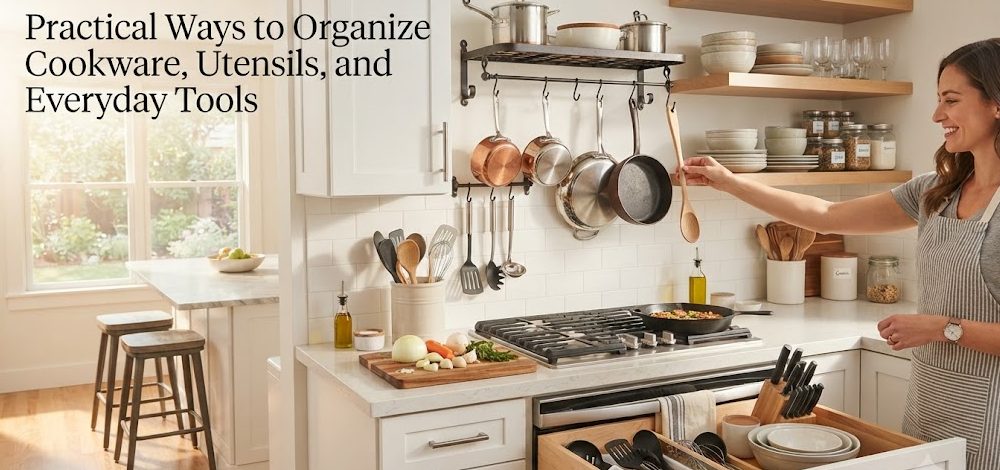
Give Every Tool a Useful Place
Cookware, utensils, and everyday kitchen tools are easiest to manage when storage follows the way you actually prepare food. A few practical changes can reduce searching, protect valuable space, and make cooking feel more natural.
A kitchen can have plenty of storage and still feel disorganized. The problem is often not a lack of cabinets or drawers, but the way items are grouped inside them. Pans become stacked too deeply, utensils disappear into crowded drawers, and everyday tools end up scattered around the room.
A better system begins with function. Instead of asking where something will fit, ask where you are most likely to need it and how often you use it. This small change in thinking can make everyday organization much easier.
Start by Sorting Everything Into Useful Groups
Before reorganizing storage, take out the cookware and tools from one area at a time. Seeing everything together makes duplicates and rarely used items easier to identify.
Keep the categories simple. You might separate cookware, cooking utensils, preparation tools, measuring equipment, serving tools, and specialty items.
A practical sorting question
Don’t organize items according to what looks neatest. Organize them according to how often they are used and where they are used.
Give Frequently Used Cookware the Easiest Access
The pans and pots you use several times a week should not be buried behind equipment that comes out once or twice a year.
Keep everyday cookware in the most convenient cabinet, drawer, or storage area that safely accommodates it. Larger specialty cookware can occupy less accessible spaces.
Closest and easiest to reach
Convenient cabinet or drawer
Higher or less accessible storage
Store Pans So They Are Easy to Remove
Deeply stacked cookware can make even a simple meal frustrating. If you need the pan at the bottom of the pile, every item above it has to be moved first.
When your space allows, consider vertical or semi-vertical storage methods that let individual pans be accessed more easily. Suitable dividers, racks, or cabinet organizers can help, but they are not essential if a simple rearrangement already solves the problem.
Another useful approach is to group pans by frequency of use rather than size alone. The pan you use every day should not be hidden simply because it happens to be the largest or smallest.
Separate Lids From the Cookware Stack
Cookware lids often create more clutter than the pots themselves. They are awkward to stack and can easily become mixed together.
If possible, give lids their own section or store them vertically. Grouping them by cookware type can also make matching a lid with the correct pot or pan much faster.
If a particular lid belongs to a pan you use regularly, make sure the two items are stored close enough that retrieving them does not become a separate search.
Create a Dedicated Home for Cooking Utensils
Spatulas, wooden spoons, tongs, ladles, whisks, and similar tools are easier to manage when they share a clearly defined storage area.
Depending on your kitchen, this might be a drawer, container, holder, or another suitable location. The important thing is that the storage method allows you to see what you have rather than creating a deep pile of tools.
If you use a utensil container near the stove, avoid filling it with every kitchen tool you own. Keep the everyday selection limited enough that individual tools remain easy to identify.
Organize Utensils by Cooking Task
When a drawer contains dozens of unrelated tools, finding one item can take longer than actually using it. Grouping utensils according to their purpose can make the drawer more intuitive.
Spatulas, spoons, and other cooking utensils.
Whisks, measuring tools, and mixing accessories.
Serving spoons, tongs, and related tools.
Keep Preparation Tools Near Your Main Work Surface
Knives, cutting boards, peelers, graters, and mixing bowls are usually part of the preparation stage rather than the cooking stage. Keeping them near the primary preparation area can reduce unnecessary movement.
The same principle applies to measuring cups and spoons if you use them frequently. Storage does not need to be perfect; it simply needs to support the sequence in which you work.
Use Drawer Dividers Only When They Solve a Problem
Drawer dividers can be useful, especially when tools frequently become mixed together. But adding compartments to every drawer is not automatically an improvement.
Use dividers when they help maintain clear categories or prevent tools from shifting around. Avoid creating so many small sections that returning an item becomes inconvenient.
A good organizer should do one thing well
It should make an item easier to find, easier to remove, or easier to put away. If it does none of these things, it may simply be taking up additional space.
Create a Small Everyday Tool Collection
Many kitchens contain far more tools than are needed for ordinary meals. Identify the handful of items you reach for repeatedly and make those especially accessible.
Your everyday collection might include one dependable knife, cutting board, pan, spatula, cooking spoon, tongs, mixing bowl, and measuring tools. The exact selection will vary according to your cooking habits.
The point is not to limit yourself unnecessarily. It is to make everyday cooking tools easy to reach without forcing them to compete with specialty equipment.
Give Specialty Tools a Separate Home
Specialty equipment should not take over the space needed by everyday tools. Baking accessories, seasonal cookware, entertaining supplies, and rarely used gadgets can be grouped together and stored outside the main workflow.
This makes it easier to maintain your everyday storage while still keeping useful specialty items available when you need them.
Use Vertical Storage for Flat Items
Cutting boards, baking sheets, trays, and similar flat items can consume a large amount of cabinet space when stacked horizontally.
Where appropriate, vertical dividers can allow these items to stand separately. This can make it much easier to remove one tray without disturbing everything around it.
Flat Storage
Useful for items that stack comfortably and are accessed together.
Vertical Storage
Useful when you want individual trays, boards, or similar items to be easier to retrieve.
Keep Measuring Tools Together
Measuring cups, spoons, kitchen scales, and similar tools often end up scattered across several drawers. Keeping related measuring equipment together can make recipe preparation more efficient.
If you use measuring spoons frequently, store them somewhere that does not require moving unrelated utensils out of the way first.
Remove Broken and Unused Tools
Damaged tools and duplicate equipment take up valuable storage space. A compact kitchen becomes noticeably easier to organize when you remove things that no longer work properly or are unlikely to be used.
Also look for tools that were purchased for one specific recipe or trend but have not been touched since. If something genuinely earns its place, keep it. If not, consider whether its storage space could be better used.
For every rarely used tool, ask whether you would choose to buy it again today. The answer can help identify unnecessary duplicates and forgotten gadgets.
Store Heavy Cookware Where It Is Comfortable to Handle
Large pots, cast-iron-style cookware, and other heavy items should be stored in locations that allow you to lift and return them safely and comfortably.
Good organization is not just about appearance. Storage should also make everyday handling easier and reduce awkward reaching whenever possible.
Label Only When Labels Add Value
Labels can help when storage categories are not obvious or when several people share the kitchen. But labeling every drawer and container may create unnecessary maintenance.
Use labels for areas where they genuinely improve consistency. If everyone can already identify the correct storage location, a label may not be necessary.
Create a Simple Return-to-Home Habit
Organization works best when putting something away is almost effortless. After cooking, return each tool to its normal location instead of placing it wherever there happens to be room.
This small habit prevents clutter from slowly spreading throughout the kitchen. It also means the next cooking session begins with a clean, predictable setup.
The three-step reset
- Return cookware to its assigned storage area.
- Put everyday utensils back into their category.
- Clear tools from the main preparation surface.
Review Your Storage After a Week
Do not assume your first arrangement will be perfect. Use the kitchen normally for several days and notice what keeps going wrong.
If you constantly leave one utensil on the counter, perhaps its drawer is too inconvenient. If you repeatedly move the same pan to reach another, the cookware stack may need adjustment.
Your daily habits provide valuable feedback. Good organization is often the result of observing those habits and making small corrections.
Avoid Turning Organization Into More Clutter
The temptation to buy racks, bins, holders, and containers can be strong when a kitchen feels crowded. But storage products should come after you understand the problem.
First remove unnecessary items and improve the arrangement of what remains. Then consider whether a specific organizer would make access easier. This prevents the common situation where organizers simply create more places to store things you do not use.
A practical order of operations
Declutter → Group → Assign locations → Improve access → Add storage only if necessary.
Make the System Match Your Cooking Style
A baker, a quick-meal cook, and someone who prepares large family dinners may need completely different storage arrangements. There is no single correct kitchen system.
Pay attention to your most common cooking sequence. If you usually prepare ingredients first, keep preparation tools together. If you frequently move between the stove and counter, keep cooking utensils within easy reach of both areas.
The best organization system is the one that feels natural enough to maintain without constant effort.
Organize for Access, Not Just Appearance
The most practical cookware and utensil organization systems are built around frequency, function, and convenience. Keep everyday tools close, separate specialty equipment, make cookware easier to retrieve, group utensils by task, and give every important item a predictable home.
You do not need a perfectly styled kitchen or a collection of expensive organizers. Start by removing what you do not need, rearrange what you already own, and make small adjustments based on how you actually cook. When your storage supports your routine, everyday cooking becomes quicker, calmer, and much easier to manage.